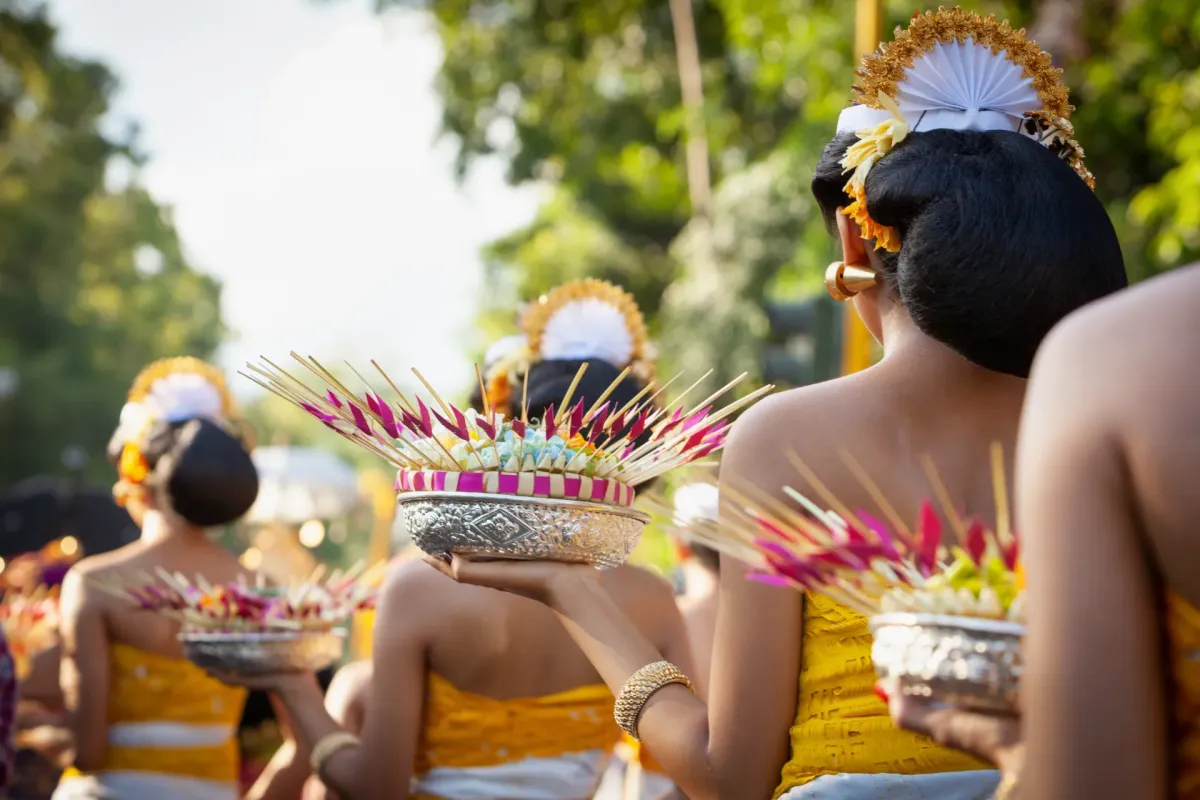
If you spend more than a few days exploring Bali, you will inevitably encounter a road closed off by red-and-white barrier poles, guarded by local village security men in black-and-white checkered sashes (Pecalang). In the distance, the resonant pulse of a Gamelan orchestra echoes through palm trees. A procession of dozens of Balinese women glides along the roadside dressed in elegant yellow and white lace kebayas, gracefully balancing towering three-foot-high pyramids of fruit and rice cakes upon their heads. You have just crossed paths with a Piodalan—the sacred anniversary celebration of a Balinese temple.
Because Bali possesses more than 20,000 public and clan temples—and every single sanctuary celebrates its own anniversary every 210 days (or once every solar-lunar year)—several hundred Piodalan festivals occur across the island on any given day. Far from being a tourist attraction, the Piodalan is the living engine of Balinese community solidarity, artistic expression, and spiritual renewal. This comprehensive guide reveals how temple birthdays are scheduled, what sacred rituals take place inside the courtyards, and how foreign travelers can witness these vibrant festivals respectfully.
1. What is a Piodalan? The Temple's Sacred Birthday
The term Piodalan (often referred to colloquially by locals as an Odalan) derives from the Balinese root word Wedal, which translates to “birth,” “appearance,” or “to emerge into the world.”
A Piodalan marks the exact anniversary date when a temple’s foundational consecration ceremony (Pemlaspas) took place. In Balinese Hindu theology, the tiered stone pagodas and wooden shrines (Meru and Pelinggih) of a temple are not permanent homes for the deities; rather, they are sanctified vehicles or landing stations. On the sacred days of the Piodalan, the supreme divinity, ancestral spirits, and protective deities descend from their heavenly abodes to dwell temporarily within the sanctified courtyard. For three to eleven consecutive days, the local community serves as divine hosts, showering their heavenly guests with feasts, music, theatrical entertainment, and heartfelt devotion.
2. How Piodalan Dates are Calculated: Two Calendar Systems
One of the most fascinating aspects of Balinese religious scheduling is that different temples follow different calendar systems to determine their festival dates, as explored in our guide to the Balinese calendar systems:
1. The 210-Day Pawukon Cycle
The overwhelming majority of village community temples (Pura Kahyangan Tiga) celebrate their Piodalan based on the 210-day Pawukon cycle. The date is fixed to a specific intersection of the 7-day week (Saptawara), 5-day week (Pancawara), and 7-day week cycle (Wuku). For example, a temple might celebrate its anniversary every Buda Cemeng Klawu (Wednesday-Wage in the week of Klawu), which recurs exactly every 210 days.
2. The Lunar Saka Year
Major regional sanctuaries and supreme mountain mother temples—such as Pura Besakih, Pura Ulun Danu Beratan, and Pura Ulun Danu Batur—frequently celebrate their grand festivals according to the Saka lunar calendar. Their ceremonies coincide with auspicious full moon days, most notably Purnama Kadasa (the 10th Full Moon, usually in March or April) or Purnama Kalima (the 5th Full Moon in autumn).
3. The Three Stages of a Piodalan Festival
A full village Piodalan is a massive logistical undertaking that transforms the entire community for weeks:
Phase 1: Preparation (Ngayah and Matengen-tengen)
Days before the festival begins, the local village neighborhood collective (Banjar) gathers in the temple for Ngayah—voluntary, joyous communal labor performed without monetary pay. Men harvest tall curved bamboo poles from the jungle to craft soaring Galungan-style Penjor arches, erect palm-thatch shade pavilions, and carve roast suckling pigs. Women spend dozens of hours weaving intricate coconut-leaf decorations (Jejaitan) and preparing mountains of offerings.
Phase 2: The Sacred Procession (Mepeed)
On the opening day, the village performs Melasti or Mendak Batara—marching sacred heirloom statues (Pratima) to the nearest holy spring, river, or ocean to be ritually cleansed with holy water. The procession is known as Mepeed: hundreds of village women walk in single file, each bearing a breathtaking Gebogan fruit offering stacked two to four feet high on their heads with effortless posture.
Phase 3: The Climax: Prayers, Sacred Dances, and Midnight Gamelan
In the inner sanctum (Jeroan), officiating high priests ring brass prayer bells (Genta), chant Sanskrit verses, and sprinkle blessed water (tirta). Meanwhile, sacred ceremonial dances are staged in the courtyard to entertain the gods:
- Rejang Dewa: An ethereal, hypnotic line dance performed by young, unmarried village maidens dressed in white and gold, guiding ancestral spirits down from the heavens.
- Baris Gede: An ancient warrior dance performed by village men brandishing spears and shields, standing as protective guardians against negative energies.
- Topeng Sidhakarya: A masked theatrical performance featuring a fierce, white-faced priest with protruding fangs, whose final comic blessing ensures the ritual is valid, auspicious, and complete.
4. What Happens to the Offerings After the Festival?
Foreign visitors often marvel at the mountains of tropical fruit, woven rice cakes, duck roasts, and sweet meats stacked inside the temple pavilions, wondering if the food goes to waste. The answer is an emphatic no.
In Balinese Hindu belief, the gods and ancestors consume only the Sari—the invisible spiritual essence, scent, and devotion of the offering. Once the priests have consecrated the offerings with holy water and the ceremonies conclude, the physical food becomes Surudan (divinely blessed food). Families carry their towering Gebogan fruit pyramids back to their home compounds, where the fruit is shared among relatives, neighbors, and children during joyous post-festival meals.
5. Visitor Etiquette: Can Foreigners Enter a Piodalan?
Balinese communities are exceptionally hospitable and welcome respectful foreign travelers to observe their Piodalan celebrations. However, you must observe strict cultural rules:
- Full Ceremonial Attire: You must wear full Balinese traditional dress: a clean batik kamben (sarong), a waist sash (selendang), a collared shirt or kebaya covering the shoulders, and for men, a traditional folded headcloth (Udeng). Entering in casual shorts or beachwear will cause you to be politely turned away at the gate.
- Observe Spiritual Purity (Sebel): Never enter if you are menstruating, carrying an open bleeding cut, or in active mourning for a deceased family member, as detailed in our guide to Bali temple etiquette.
- Do Not Interfere with Prayers: Sit or stand quietly along the periphery of the courtyard. Never walk directly in front of kneeling worshippers or step between a praying devotee and the shrine they are facing.
6. Frequently Asked Questions (FAQ)
How long does a Piodalan festival last?
A smaller neighborhood family shrine or village temple festival typically lasts for three consecutive days. However, major supreme mother temples—such as Pura Besakih or Pura Batur—celebrate grand festivals lasting eleven days to an entire lunar month (known as Nyelem), during which pilgrims from across the island visit daily.
Are there entrance tickets for a village Piodalan?
No. Authentic village Piodalan festivals are community religious rites, not commercial events. While there are no ticket booths, visitors frequently leave a modest voluntary donation (typically IDR 20,000 to 50,000) inside an offering basket at the entrance to support temple maintenance.
What is the best time of day to witness a Piodalan?
While daytime hours feature ongoing blessings and processions, the most enchanting atmosphere occurs after sunset—between 7:00 PM and midnight—when thousands of oil lamps illuminate the courtyards, gamelan orchestras play in competition, and sacred drama troupes perform under the stars.